Conquering the “Side-Sleeper’s Ache”: A Guide to Relieving Lateral Hip Pain
Waking up with a sharp, throbbing ache on the outside of your hip can make the simplest tasks feel like a mountain to climb. That persistent pain, often centered right over the bony prominence of your outer hip (the greater trochanter), is frequently caused by Gluteal Tendinopathy.
For many, the night is when the battle is toughest. If you’re a side-sleeper, you might be unknowingly aggravating your hip for eight hours straight. Here is how to understand the pain and, more importantly, how to fix it.
What is Lateral Hip Pain?
Lateral hip pain is an umbrella term for discomfort on the outer side of the hip joint. The most common culprit is Gluteal Tendinopathy—an irritation or “wear and tear” of the tendons that connect your glute muscles to your hip bone.
Common Causes:
- Compression: This is the #1 enemy for sleepers. Lying on your side “pinches” the tendon against the bone, cutting off blood flow and causing inflammation.
- Overuse: Repetitive movements like walking, running, or climbing stairs without adequate glute strength.
- Biomechanical Stress: If your pelvis tilts or your knees “cave in” while moving, it places a shearing force on the tendons.
Mobility Exercises for Relief
To start your recovery, complete these 3 exercises for 2 sets of 12-15 reps each. These are designed to “prime” the tendon and build the support your hip needs.
1. Lying Side Abduction Leg Raise (Isometric)
- How: Lie on your non-painful side with your bottom leg bent for stability. Keep your top leg perfectly straight and shifted slightly behind your torso.
- The Movement: Lift your top leg 8–10 inches toward the ceiling. Instead of moving up and down, hold it steadyfor 5–10 seconds per rep.
- Why: This static hold builds tendon resilience and hip stability without the painful friction caused by repetitive movement.
2. Prone Glute Hip Extension
- How: Lie flat on your stomach with your forehead resting on your hands. Keep your legs straight and your spine neutral.
- The Movement: Squeeze your glute and lift one leg 3–5 inches off the floor. Hold the squeeze for 2–3 seconds at the top before slowly lowering.
- Why: This strengthens the “powerhouse” glute max without putting any pinching pressure or compression on the sensitive tendons on the side of your hip.
3. Glute Bridges
- How: Lie on your back with knees bent and feet flat on the floor, hip-width apart.
- The Movement: Drive through your heels to lift your hips toward the ceiling, squeezing your glutes hard at the top. Lower back down slowly.
- Why: Strengthening the glute max provides a stable base for the pelvis, which takes the “workload” and strain off the irritated lateral tendons.
Mastering Your Sleep Position
Your sleep setup is your primary recovery tool. The goal is to keep the hip in a “neutral” position.
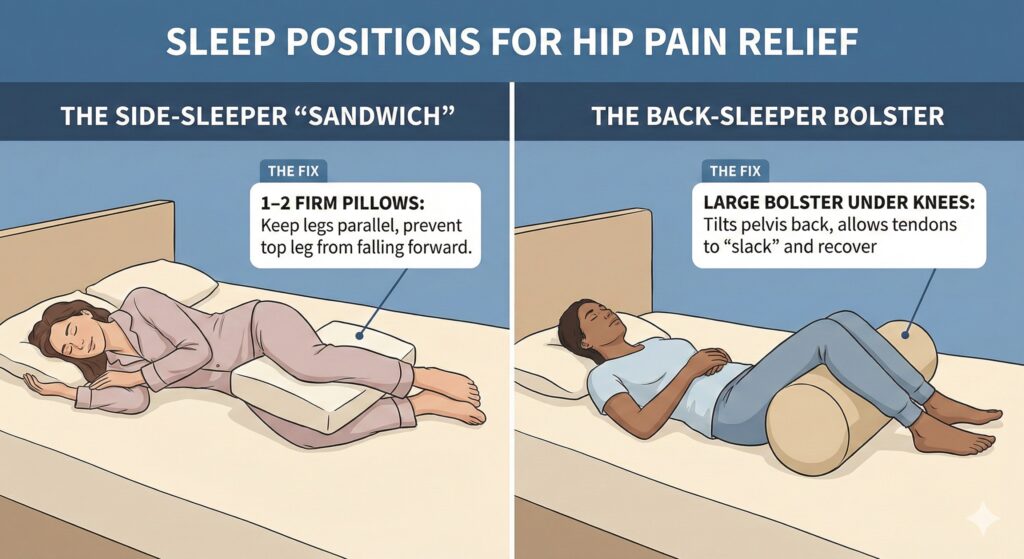
The Side-Sleeper “Sandwich”
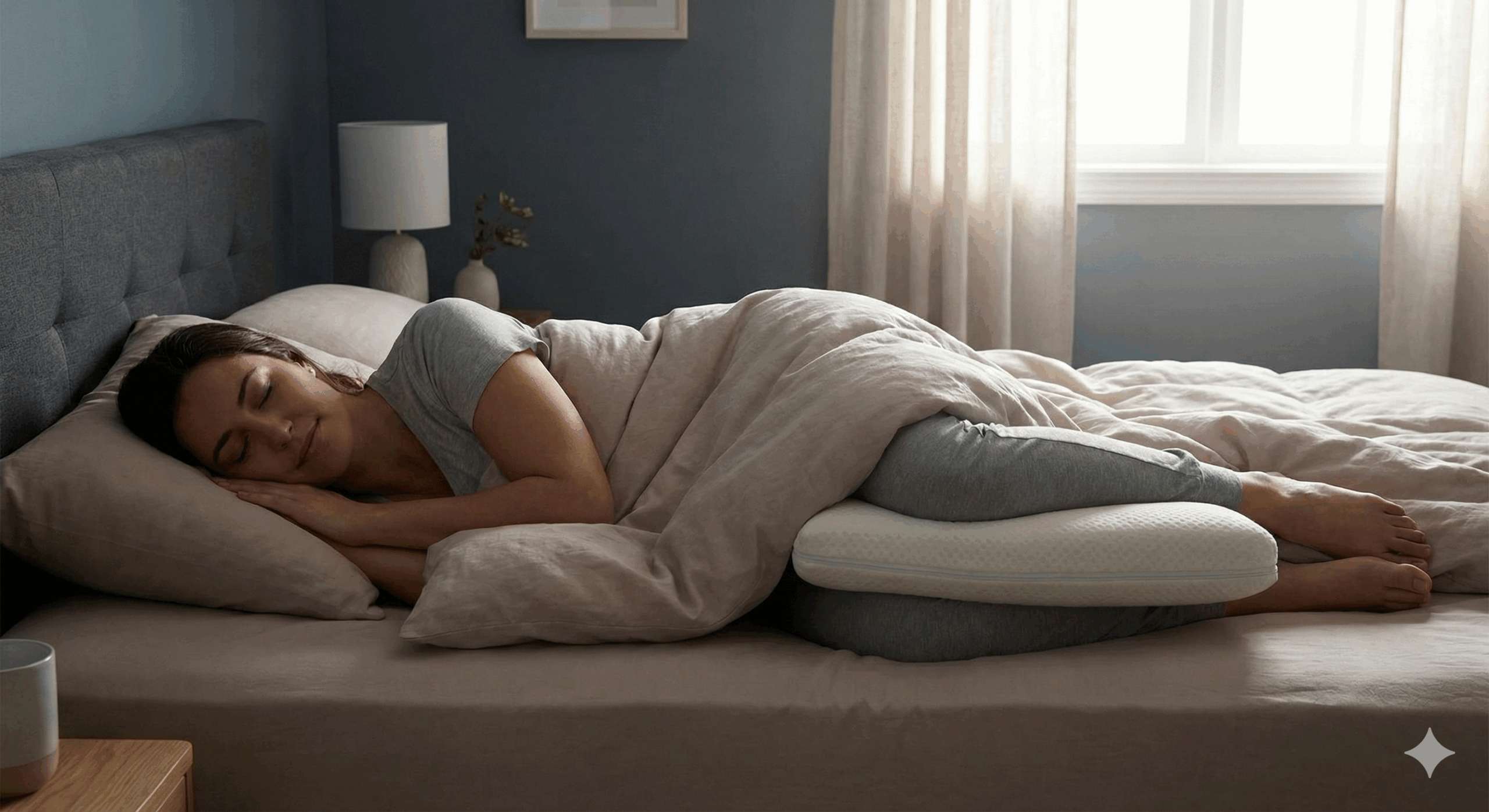
If you must sleep on your side, you cannot let your top leg fall forward and touch the mattress. This stretches the tendon to its limit and compresses it against the bone.
- The Fix: Place 1–2 firm pillows between your knees and ankles. Your top leg should be perfectly parallel to the mattress, not angled down.
The Back-Sleeper Bolster
Sleeping on your back is the best way to heal because it removes all pressure from the side of the hip.
- The Fix: Place a large pillow or bolster under your knees. This tilts your pelvis back and allows the gluteal tendons to “slack” and recover.
Your Recovery Toolkit
- OTC Medications: Anti-inflammatories like Ibuprofen (Advil) or Naproxen (Aleve) can help manage the “fire” of acute inflammation.
- Topical Ointments: Voltaren (Diclofenac) Gel is highly effective here because the hip tendon is close to the skin’s surface. Menthol-based creams like Biofreeze can also provide temporary “distraction” from the pain.
- Recovery Techniques: Use Ice for 15 minutes after activity to dull sharp pain. Use Heat for 15 minutes before your mobility exercises to increase blood flow and flexibility.
Get a Systematic Game Plan
While these tips provide a great starting point, lasting relief requires a targeted approach to how your body moves as a whole.
At Full Circle Fitness, our Pain Reduction Fitness Specialists can help you go beyond the “quick fix.” We specialize in developing a systematic game plan to strengthen your supporting muscles, correct your gait, and alleviate your lateral hip pain for good. Don’t settle for “managing” the pain—let’s work together to eliminate it. Reach out to us today to start your personalized path to pain-free movement.