

Chronic pain management
exercise & Aging
Injury Prevention & Recovery
Explore the Categories

right this way
Work with us
Personalized Fitness Sessions to Alleviate Chronic Pain and Enhance Your Life!

The Power of Stillness: How Isometrics Can Transform Senior Health and Injury Recovery
January 28, 2026
When we think of “exercise,” we usually picture movement: the upward push of a bench press, the stride of a runner, or the flow of a yoga sequence. But some of the most profound benefits for aging bodies and injury rehabilitation come from the exercises where you don’t move at all.
Welcome to the world of isometrics.
What Exactly Are Isometrics?
In technical terms, an isometric contraction occurs when a muscle produces force without changing length and without visible movement in the joint.
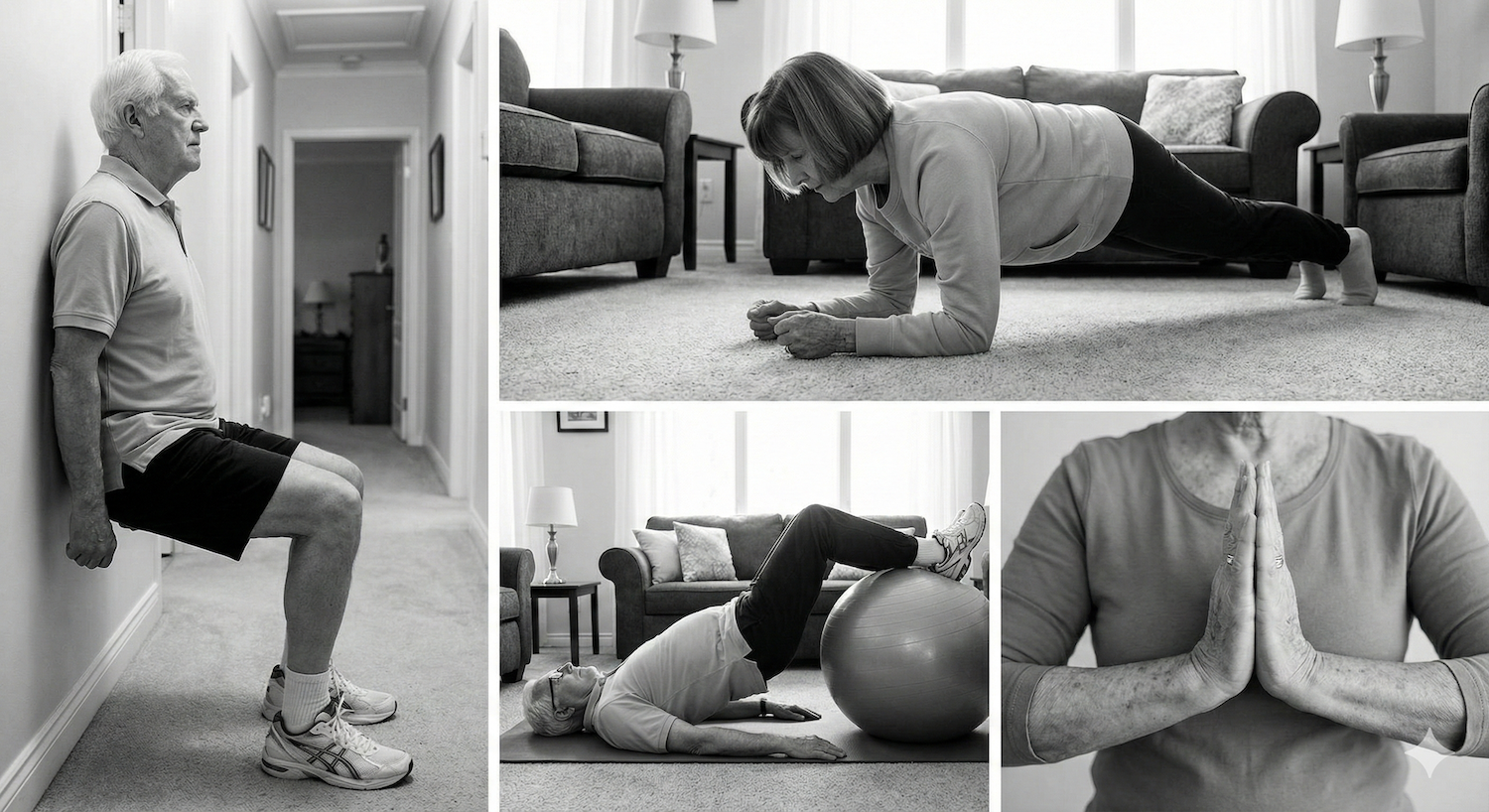
Think of a plank, a wall sit, or simply pressing your palms together as hard as you can. You’re working—often quite hard—but your joints remain static. This “still strength” is a secret weapon for longevity and physical therapy.
1. The Ultimate Tool for Injury Recovery
Recovering from an injury often feels like a “Catch-22”: you need to strengthen the muscle to heal, but moving the joint hurts too much to exercise. Isometrics break this cycle.
- Pain Management: Research shows that isometric holds can have an analgesic (pain-relieving) effect on tendons and joints.
- Safe Strengthening: Because there is no impact or range-of-motion requirement, you can maintain muscle mass even when a joint is immobilized in a cast or brace.
- Neural Drive: Isometrics “remind” your brain how to recruit muscle fibers that might have gone dormant due to injury-related inhibition.
2. Combatting Aging Deficiencies (Sarcopenia & Osteoporosis)
As we age, we naturally lose muscle mass (sarcopenia) and bone density. Isometrics offer a low-impact way to fight back.
- Joint-Friendly Load: Seniors often struggle with arthritis or “creaky” knees. Isometrics allow for high-intensity muscle activation without the “wear and tear” of repetitive grinding in the joints.
- Bone Density: By creating significant tension through the muscles and tendons, isometrics signal the bones to strengthen, helping to mitigate the risks of osteoporosis.
- Improved Balance: Stability is about the body’s ability to resist unwanted movement. Static holds train the core and stabilizer muscles, directly translating to fewer falls.
3. The “Hidden” Benefit: Cardiovascular Health
Believe it or not, holding still can help your heart. Studies have shown that isometric exercises—specifically wall sits and handgrip squeezes—are remarkably effective at lowering resting blood pressure, sometimes even more so than traditional aerobic exercise.
Note: If you have high blood pressure, always breathe through the movement. Holding your breath (the Valsalva maneuver) during an isometric hold can cause a temporary spike in pressure.
Getting Started: A Simple 4-Move Routine
You don’t need a gym or expensive equipment to start reaping these benefits. Try holding each of these for 20–30 seconds, focusing on consistent breathing throughout the hold:
| Exercise | Primary Target | Benefit for Seniors & Recovery |
| The Wall Sit | Quads, Glutes, Knees | Builds the foundational strength needed for “sit-to-stand” movements and stabilizes the knee joint. |
| The Plank | Core, Shoulders, Spine | Enhances postural alignment and protects the lower back by bracing the “natural corset” of the body. |
| Stability Ball Bridge | Hamstrings, Glutes, Low Back | Strengthens the posterior chain while the ball provides a mild instability that engages deep stabilizer muscles. |
| The Prayer Press | Chest, Shoulders, Wrists | Maintains upper body bone density and grip tension without requiring heavy lifting or overhead reaching. |
The Bottom Line
Isometrics prove that you don’t have to throw heavy weights around or run marathons to see significant health gains. By incorporating “the power of still” into your routine, you can protect your joints, speed up recovery, and build a body that is resilient enough to handle whatever the golden years throw at it.
Leave a Reply Cancel reply
Full Circle Fitness offers a progressive approach to chronic pain management through functional fitness for residents of Glendale and Denver.
FREE 60-SECOND QUIZ
Your pain has a cause. Let's find it.
Answer 5 quick questions to discover what's driving your pain and get a customized action plan.
MOVEMENT PROFILE QUIZ
1 of 5
Where is your primary source of daily, nagging pain?
When does your pain usually flare up the most?
How would you describe the physical sensation of the pain?
Be honest: what usually happens when you try to stretch the painful area?
Let's do a quick physical test. Sit on the edge of a chair, cross your arms over your chest, and stand up. What happens?
Your custom movement profile is ready!
Enter your email below to reveal your root cause and action plan.
YOUR MOVEMENT PROFILE
The Weak Stabilizer
Your deep stabilizing muscles — the small, postural muscles that are supposed to quietly control and protect your joints — have gone dormant. Without them doing their job, the impact of everyday movement gets dumped straight onto your joints instead of being absorbed by muscle, which is exactly why the ache keeps coming back.
Book a $98 ConsultationYOUR MOVEMENT PROFILE
The Locked Joint
You're dealing with a genuine mobility restriction. Tight tissue is essentially "gluing" the joint down, blocking its full range of motion — so every time you push through it, you're forcing movement your body physically isn't ready to give you yet.
Claim a $450 Intro 5-PackYOUR MOVEMENT PROFILE
The Compensator
Your body has developed a side-to-side strength imbalance — one side has quietly taken over for the other. That constant overwork is exactly what's driving the irritation, and it won't resolve until both sides are pulling equal weight again.
Get a 10-Pack & Free Assessment for $940