Moving Through the Static: How Daily Exercise Eases Chronic Neuropathy
When your feet feel like they are walking on glass, or your hands are constantly tingling with pins and needles, the absolute last thing you probably want to do is exercise. Chronic neuropathy and nerve pain can make your own body feel like an unpredictable environment. The natural instinct is to stop moving, sit down, and protect the painful areas.
But modern science tells us something completely counterintuitive: sitting still is often the worst thing you can do for nerve pain.
While rest is important, strategic daily movement is one of the most powerful, non-prescription tools you have to manage chronic neuropathy, protect your balance, and reclaim your quality of life.
Here is exactly how exercise fights nerve pain, and how you can safely start a routine today.
Why Movement is Medicine for Your Nerves
Nerves are living tissues. To survive, function, and repair themselves, they need a constant supply of oxygen and nutrients. When you are sedentary, circulation slows down, leaving damaged nerves starved of what they need to heal.
Here is what happens inside your body when you commit to daily movement:
| The Mechanism | How It Fights Neuropathy |
|---|---|
| Increased Blood Flow | Exercise acts as a pump, pushing oxygen-rich blood all the way down to the tiny capillaries in your hands and feet to nourish damaged peripheral nerves. |
| Blood Sugar Control | For those with diabetic neuropathy, muscle contractions burn glucose, stabilizing blood sugar and preventing further nerve damage. |
| Endorphin Release | Physical activity triggers the release of endorphins—your body’s natural painkillers—which help dial down the volume of chronic nerve pain. |
| Preserved Brain-Body Connection | Movement forces your brain to “talk” to your limbs, keeping those neurological pathways active and reducing the static. |
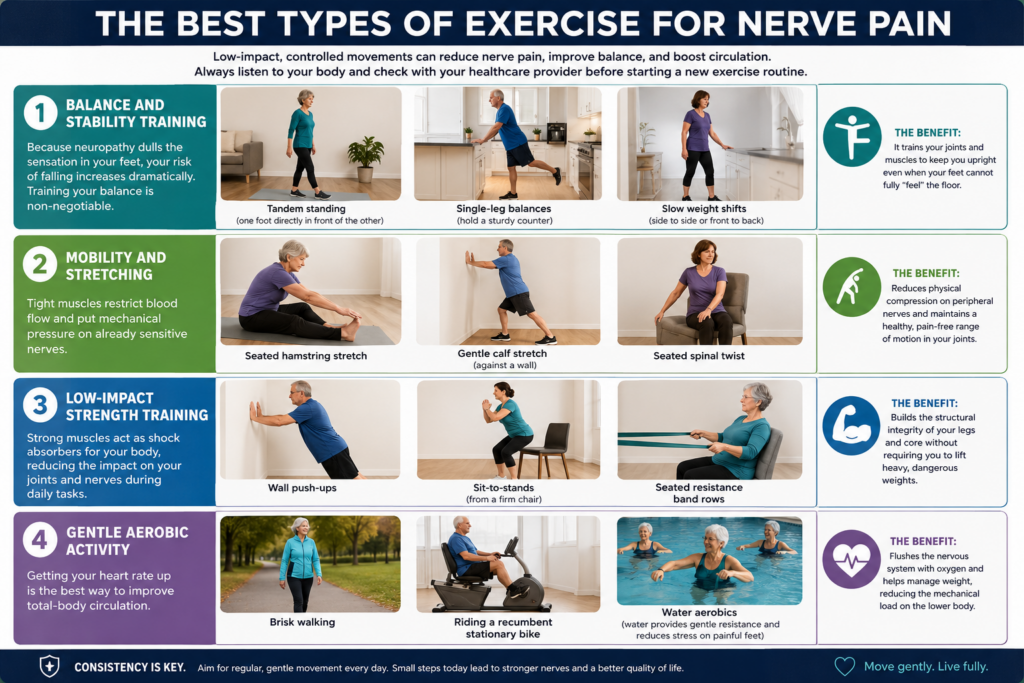
The Best Types of Exercise for Nerve Pain
You do not need to jump into a high-intensity boot camp to get results. In fact, low-impact, highly controlled movements are vastly superior for nerve health.
1. Balance and Stability Training
Because neuropathy dulls the sensation in your feet, your risk of falling increases dramatically. Training your balance is non-negotiable.
- The Moves: Tandem standing (placing one foot directly in front of the other), single-leg balances while holding a sturdy kitchen counter, and slow weight shifts.
- The Benefit: It trains your joints and muscles to keep you upright even when your feet cannot fully “feel” the floor.
2. Mobility and Stretching
Tight muscles restrict blood flow and put mechanical pressure on already sensitive nerves.
- The Moves: Seated hamstring stretches, gentle calf stretches against a wall, and seated spinal twists.
- The Benefit: Reduces physical compression on peripheral nerves and maintains a healthy, pain-free range of motion in your joints.
3. Low-Impact Strength Training
Strong muscles act as shock absorbers for your body, reducing the impact on your joints and nerves during daily tasks.
- The Moves: Wall push-ups, sit-to-stands from a firm chair, and seated resistance band rows.
- The Benefit: Builds the structural integrity of your legs and core without requiring you to lift heavy, dangerous weights.
4. Gentle Aerobic Activity
Getting your heart rate up is the best way to improve total-body circulation.
- The Moves: Brisk walking, riding a recumbent stationary bike, or water aerobics (water provides gentle resistance while taking the weight off painful feet).
- The Benefit: Flushes the nervous system with oxygen and helps manage weight, reducing the mechanical load on the lower body.
Rules of the Road: Exercising Safely
If you are ready to start moving, you must protect your hands and feet in the process. Follow these three rules:
- Always Check Your Feet: Neuropathy means you might not feel a blister or a pebble in your shoe. Always inspect your feet before and after exercising, and never exercise barefoot.
- Wear the Right Gear: Invest in wide-toe-box shoes that do not compress the sides of your feet, and wear moisture-wicking, seamless socks to prevent friction.
- Start Small: Consistency beats intensity every time. Start with just 10 minutes of movement a day. You can slowly build up to the recommended 30 minutes as your body adapts.
Need a Place to Start?
Navigating exercise with chronic pain can be intimidating, but you do not have to figure it out alone. At Fullcircle Fitness, we specialize in creating safe, customized, and highly effective movement routines you can do easily on your own at home. We build a program that respects your pain while actively fighting it.
Reach out today to schedule your fitness consultation today!