

Chronic pain management
exercise & Aging
Injury Prevention & Recovery
Explore the Categories

right this way
Work with us
Personalized Fitness Sessions to Alleviate Chronic Pain and Enhance Your Life!

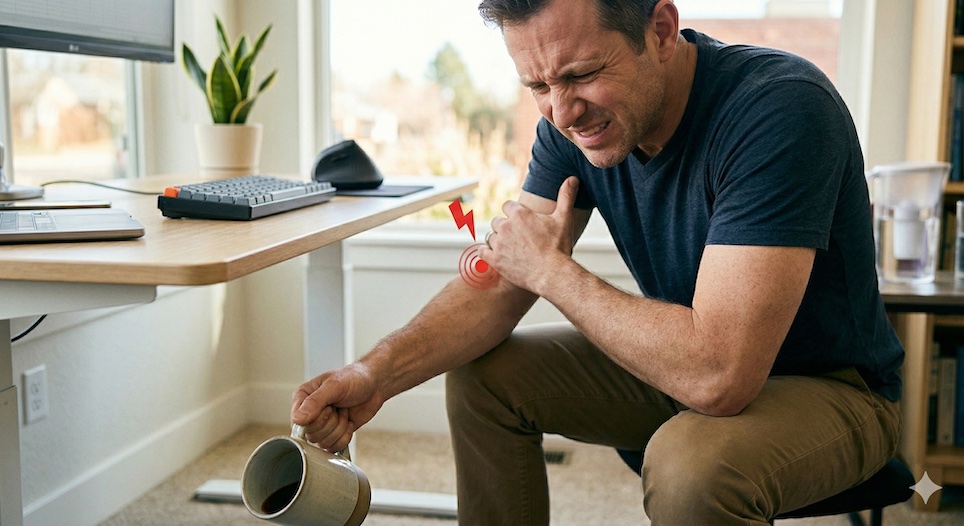
Stop the Ache: The Full Circle Guide to Fixing Chronic Computer Elbow
April 9, 2026
For millions of modern professionals, the most persistent daily injury doesn’t come from a heavy barbell or a marathon—it’s that nagging, burning “zing” in the elbow.
Often labeled “Tennis Elbow” (Lateral Epicondylitis), this painful condition routinely strikes people who haven’t picked up a racket in their lives. Instead, their playing field is a workstation, and their opponent is a keyboard and mouse.
At Full Circle Fitness, we view health through a 360-degree lens. True wellness isn’t just about the hour you spend sweating; it’s about how you support your body during the other 23 hours of the day. If typing, gripping, or clicking is causing you pain, your body is signaling that its daily workload has exceeded its tissue tolerance.
Here is our complete, step-by-step protocol to resolve chronic elbow pain, rebuild your strength, and keep the ache away for good.
## 1. The Daily Habits: Neutralize the Stress
You cannot heal a tendon that is under constant, low-grade mechanical stress. To give your elbow a chance to recover, your first line of defense is adjusting your environment.
- Adopt the “Handshake” Position: Standard computer mice force your forearm bones to cross, putting a constant, unnatural twist on your tendons. Switching to an ergonomic vertical mouse keeps your hand in a neutral handshake position. This instantly reduces the pulling tension on the lateral epicondyle (the bony bump on the outside of your elbow).
- Enforce the 90-Degree Rule: Ensure your desk and chair height allow your elbows to rest at a perfect 90° anglewith your wrists flat. If you have to reach up to type, you are forcing your forearm muscles into a state of permanent contraction.
- Master the Micro-Break: Tendons have notoriously poor blood supply compared to muscles. Every 30 minutes, step away from the keyboard for just 20 seconds. Let your arms hang completely loose at your sides and gently shake them out to flush the connective tissue with fresh blood and oxygen.
## 2. The Physical Protocol: Strength & Mobility
When elbow pain becomes chronic, the tendon fibers have become disorganized and weak. The ultimate fix isn’t just resting the joint—it is controlled, strategic loading.
### The Gold Standard Fix: Eccentric Loading
Scientific research consistently proves that eccentric exercises (strengthening a muscle while it lengthens) are the single most effective way to remodel and heal damaged tendon tissue.
- The Slow-Lower Extension: Sit with your forearm resting flat on a table, with your hand hanging off the edge. Hold a very light weight (a 2lb dumbbell, a water bottle, or a soup can). Use your pain-free hand to help lift the weight upward. Then, let go, and use only the painful arm to slowly lower the weight over a deliberate 5-second count.
- The Prescription: Perform 3 sets of 15 repetitions, once per day.
### Targeted Mobility
- The Prayer Stretch: Place your palms together directly in front of your chest. Slowly lower your hands toward your waist, keeping the base of your palms pressed tightly together until you feel a deep stretch in the forearms. Hold for 30 seconds.
- Trigger Point Release: Use your thumb or a firm massage ball to find the “meat” of your forearm muscle, about two inches below the elbow crease. Apply firm pressure and slowly flex your wrist up and down. If you hit a tender spot, hold the pressure there for 30 seconds to encourage the muscle to release its tight grip on the tendon.
## 3. Long-Term Prevention: Closing the Circle
To ensure the pain never comes back, we have to look “upstream.” Elbow issues are almost always a symptom of poor desk posture or upper back weakness.
Full Circle Fitness Tip: The “W” Raise Every time you stand up for a glass of water, perform 10 W-Raises. Tuck your elbows into your ribs and pull your hands back so your arms form the letter “W.” Squeeze your shoulder blades together. This pulls your posture out of the “hunched” typing position and takes the structural pressure off your arms.
- Check Your Monitor Height: If your screen is too low, you will naturally lean forward. This forward slump causes your elbows to flare outward, putting the joint at a mechanical disadvantage. Raise your monitor so the top third of the screen is perfectly at eye level.
- Systemic Hydration: Connective tissue is primarily composed of collagen and water. Drinking enough water ensures your tendons remain supple, elastic, and resilient, rather than dry, brittle, and prone to the micro-tears that cause tendonitis.
## The Bottom Line
Chronic elbow pain does not have to be your “new normal.” By neutralizing your workstation, committing to a daily eccentric strengthening routine, and fixing your postural habits, you can resolve the pain right at the source.
Leave a Reply Cancel reply
Full Circle Fitness offers a progressive approach to chronic pain management through functional fitness for residents of Glendale and Denver.
FREE 60-SECOND QUIZ
Your pain has a cause. Let's find it.
Answer 5 quick questions to discover what's driving your pain and get a customized action plan.
MOVEMENT PROFILE QUIZ
1 of 5
Where is your primary source of daily, nagging pain?
When does your pain usually flare up the most?
How would you describe the physical sensation of the pain?
Be honest: what usually happens when you try to stretch the painful area?
Let's do a quick physical test. Sit on the edge of a chair, cross your arms over your chest, and stand up. What happens?
Your custom movement profile is ready!
Enter your email below to reveal your root cause and action plan.
YOUR MOVEMENT PROFILE
The Weak Stabilizer
Your deep stabilizing muscles — the small, postural muscles that are supposed to quietly control and protect your joints — have gone dormant. Without them doing their job, the impact of everyday movement gets dumped straight onto your joints instead of being absorbed by muscle, which is exactly why the ache keeps coming back.
Book a $98 ConsultationYOUR MOVEMENT PROFILE
The Locked Joint
You're dealing with a genuine mobility restriction. Tight tissue is essentially "gluing" the joint down, blocking its full range of motion — so every time you push through it, you're forcing movement your body physically isn't ready to give you yet.
Claim a $450 Intro 5-PackYOUR MOVEMENT PROFILE
The Compensator
Your body has developed a side-to-side strength imbalance — one side has quietly taken over for the other. That constant overwork is exactly what's driving the irritation, and it won't resolve until both sides are pulling equal weight again.
Get a 10-Pack & Free Assessment for $940